Selected work

Niall Hewson

Head of Brand & Creative, SocialTalent Dublin, Ireland Design · Copy · Motion · Video

Pitchfork is an app I built with AI to scale customisation in presentation design. It lets any sales rep tailor the pitch for Cara, SocialTalent's AI hire for recruiting teams, to each call in minutes, without anyone, human or AI, improvising on the brand or the claims.

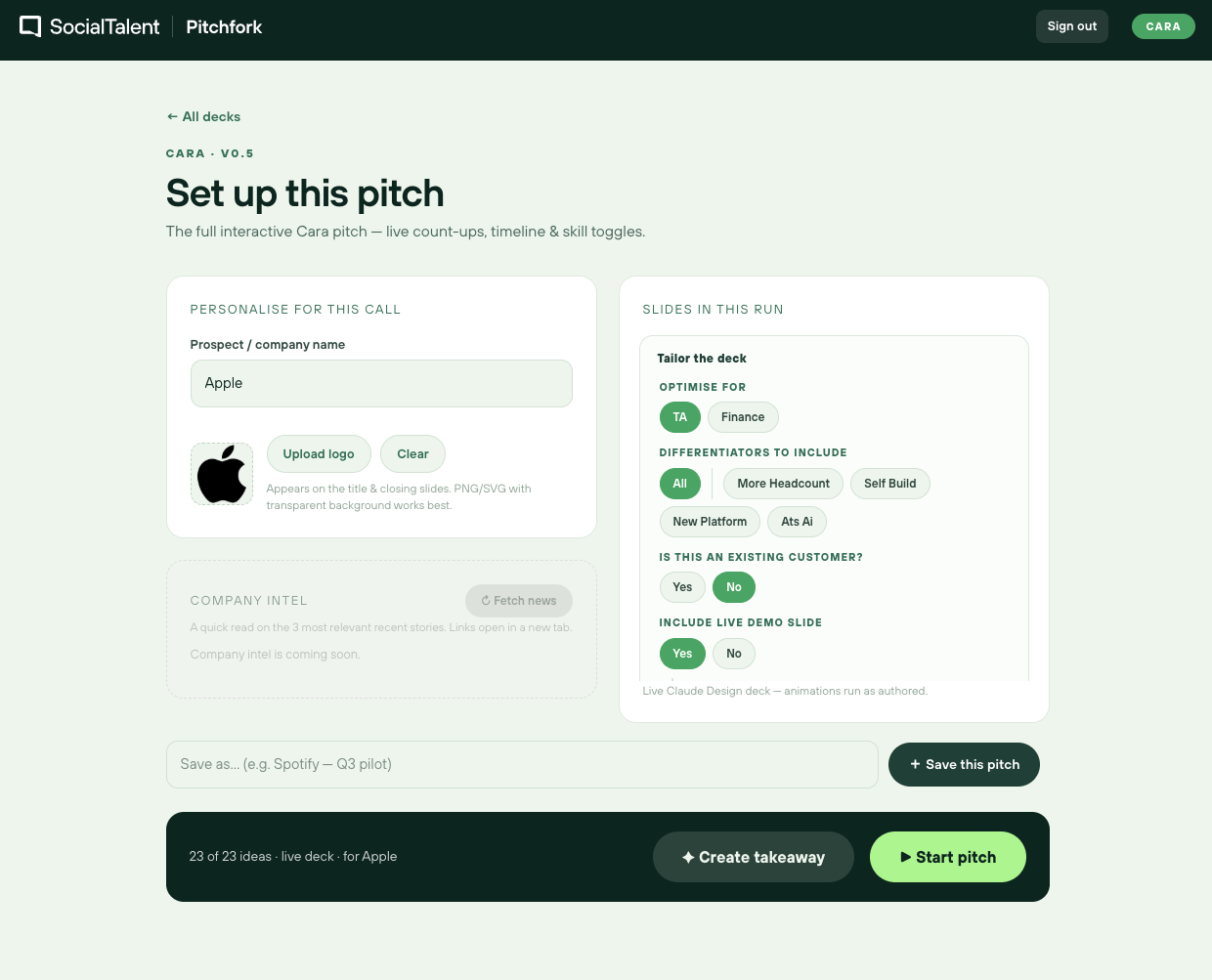
Reps add the prospect's name and logo, pick a TA or Finance audience, choose which differentiators to lead with, and decide whether to include a live demo. Then they run it as a live, animated deck built from the design system, or create a takeaway to send after the call.

Pitchfork's 'Set up this pitch' screen: a prospect name and logo on the left, and toggles on the right for audience, differentiators, existing customer and a live demo slide, above Create takeaway and Start pitch buttons.
Setting up a Cara pitch. Every option is an approved one; the slides themselves stay locked. Apple is used here as a demo prospect only; it isn't a SocialTalent customer.

How it uses AI responsibly

Choices, not a blank prompt

Reps tailor the pitch by picking from approved options. There's no free-text box that can put an off-brand layout or an unapproved claim in front of a customer.

Approved words only

The copy comes from the messaging system, so claims about Cara are stated the way the company stands behind them.

People stay in charge

AI assembles the deck from the rep's choices and drafts the takeaway, but every slide it draws on was designed by hand. The rep decides what goes in and presents it live.

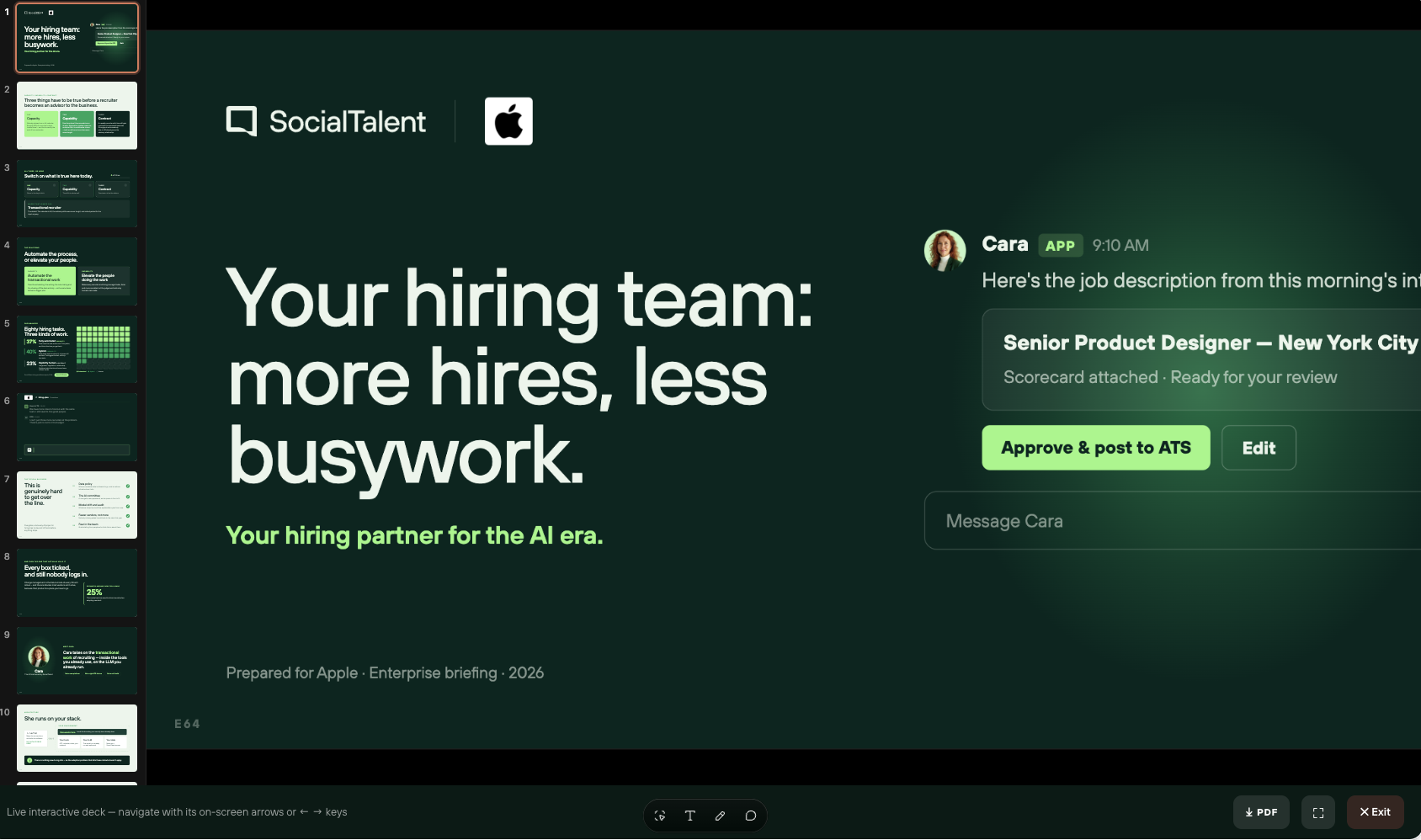
The pitch Pitchfork produces: a live, interactive deck whose title slide reads 'Your hiring team: more hires, less busywork. Your hiring partner for the AI era.' with the prospect's logo beside SocialTalent's, a Cara message in a Slack-style card, and the slides chosen for this run listed down the left, with a PDF download button.
What comes out: a live deck with the prospect's logo on the title slide and only the slides chosen for this call, ready to present or download as a PDF. Apple is used here as a demo prospect only; it isn't a SocialTalent customer.

The problem

Reps wanted pitches tailored to each prospect. Letting everyone edit slides, or prompt an AI freely, risks off-brand design and claims the company can't stand behind.

What I did

  • Built Pitchfork with Claude Design and Cowork, on top of the design system
  • Designed every slide myself, so AI only ever assembles approved work
  • Turned tailoring into a set of approved choices
  • Kept the slides locked, so every version stays on-brand

Result

Sales, and our CEO, loved being able to focus on the pitch itself rather than pulling slides together. It also let us cut our spend on other presentation apps.

SocialTalent's AI interview tools (a planner, an in-interview assistant and analytics) used to be called Interview Intelligence. They moved under a new product name, Cara: an AI hiring assistant built to grow into a whole suite of hiring features. I wrote the 31-page messaging guide that tells everyone at SocialTalent how to talk about her.

It covers the whole story: how the product and its features are named, the core messages and when to use each, the narrative behind the pitch deck, messaging for each feature, the key differentiators, and voice guidelines for describing an AI that feels human without ever sounding like a replacement for people. The guide is internal, so here I'm sharing two parts of it: the core messages and the story.

Core messages, each with one job

Shaded boxes are quoted from the guide. Everything else is my commentary.

Tagline
Your hiring partner for the AI era.

WhySignals vision. Never used alone: always followed by a line that says what Cara does.

Value proposition
Build a high-capacity, compliant, and consistent hiring function with Cara.

WhyStates the outcome, for sales decks and executive conversations.

Call to action
Bring your hiring function safely into the AI era with Cara.

WhyPrompts the next step at conversion points: product pages, closing slides, events.

Category
Cara is an AI hiring assistant.

WhyThe fast answer to "So what is it?", for comparison sites, SEO and analysts.

"Not this"
Cara doesn't accelerate bad hiring, and she doesn't replace recruiters.

WhyMeets the fear of AI head on, then says what she does instead.

The story

WhyThis is the narrative behind the Cara pitch deck, built on the Punchy story framework. It leads with the customer, names the change they're living through, and only then brings in Cara.

  1. HeroTA leaders
  2. ShiftThe AI era of hiring.
  3. VillainBeing stuck still hiring like it's 2023.
  4. ObstaclesIllegal use of AI in hiring triggering major fines. Fast, misaligned hiring driving costly mistakes. The industry-wide expectation to do more with less. AI-assisted candidates making it harder to assess real capability.
  5. DreamThat our customers can trust that their teams are hiring the best people, quickly and safely, across their entire organization.
  6. SolutionBuild a high-capacity, compliant, and consistent hiring function with Cara.

The brief

Interview Intelligence was being renamed Cara and becoming a suite. Sales, marketing and product needed one clear, consistent way to talk about her.

What I did

  • Set the naming: Cara is the product, Interview Intelligence her first feature set
  • Wrote the core messages and when to use each
  • Built the story on the Punchy framework

Result

The story became the foundation of the Cara pitch deck, and the messaging now runs through everything we say about Cara, from the website and sales enablement to event booths. It has kept evolving since this first version, as messaging should.
Four videos from ten years of production at SocialTalent. Each shows a different side of the work, and a different role in making it.

Motion graphics · 1:35

Cara from SocialTalent

A product film introducing Cara, the AI hire that takes on the transactional work of recruiting, shown working inside Slack with a hiring team.

My roleConcept, script, storyboarding and art direction

Event · 3:37

Supper Club Barcelona 2026

Talent leaders from companies including NielsenIQ, Accenture and Ferrero on SocialTalent's Supper Club event in Barcelona, cut with footage from the sessions.

My roleFilming

Learning · 3:07

The Power of Moments

A lesson from SocialTalent's learning product with Dan Heath, co-author of The Power of Moments, on designing onboarding and candidate experiences people remember. Expert to camera, with an animated sequence.

My roleProducing, directing and editing

Employer brand · 1:40

Why do you hate your job?

We put the question in the title to the SocialTalent team with no warning. Caught off guard, they turned it around and talked about why they love their jobs, more naturally than any scripted answer could. It's an older video, but people who've since joined still tell me it's what convinced them to apply.

My roleConcept, questions, filming and editing

SocialTalent had basic brand guidelines. I combined them with my messaging guidelines for Cara, SocialTalent's AI hire for recruiting teams, and rebuilt both as one design system in Claude Design, with rules exact enough for AI to follow without guessing.

It brings two sources of truth together: the Brand Guidelines for the visuals and the Cara Messaging Bible for the words. Customer-facing copy isn't a suggestion: approved lines are used verbatim. Around them sit the palette, type, geometry, 17 named components and the rules for Cara herself.

Shaded boxes are quoted from the design system. Everything else is my commentary.

How it's built for AI

Numbers, not adjectives
Diameter 26% of the portrait measured to the outer edge, flush bottom-right, with a 4% border in the surface colour. Below 24px it comes off rather than shrinks.

Why"Make it look right" is a judgement call. A ratio gives a person and a model the same answer at every size.

Rules with reasons
No away, no busy, no animation: the dot describes the task, never her availability, which is the objection the product answers.

WhyA rule that explains itself can be applied to cases it never mentions.

A test anyone can run
If it would look strange applied to a real employee's photo, it is wrong here.

WhyOne line rules out robots, glows and holograms without listing them all.

The system

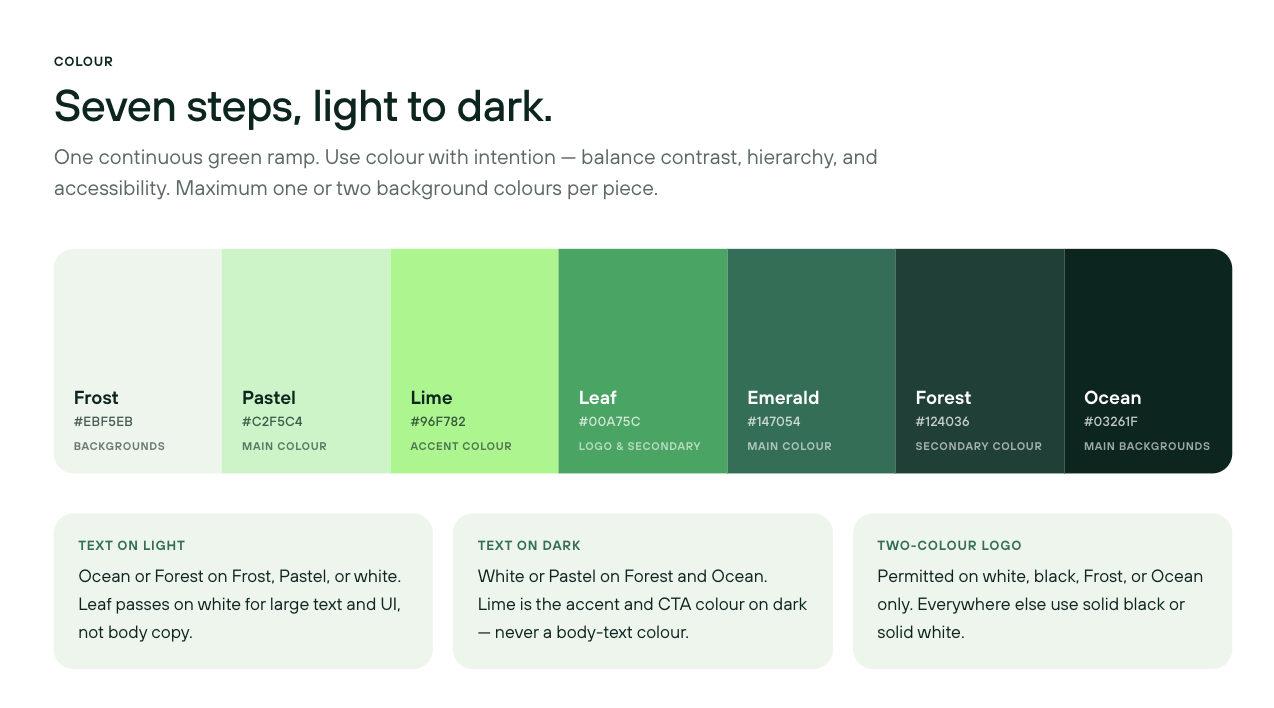
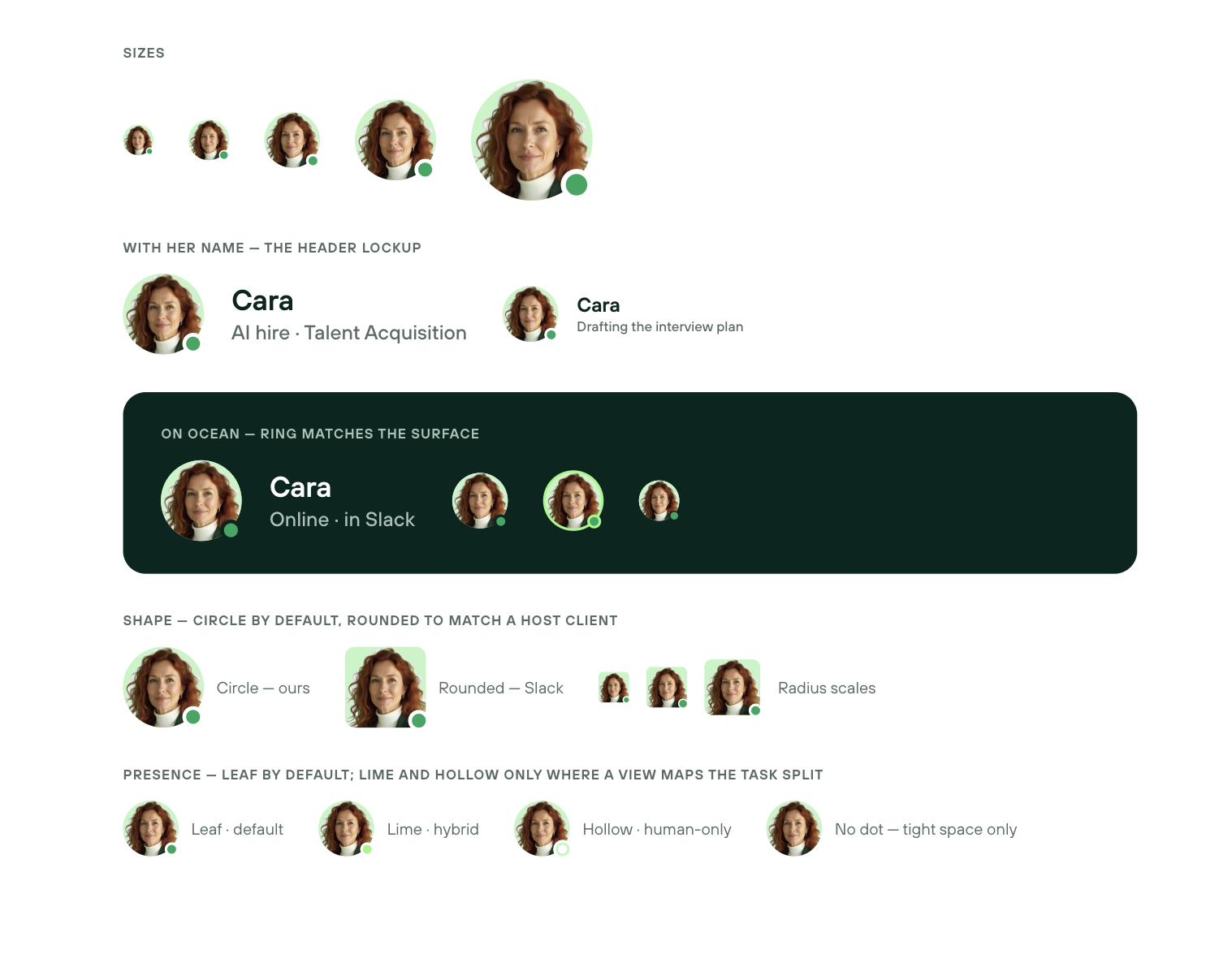
The design system covers colour, type, geometry, components and the rules for depicting Cara. Here are two of its pages: the colour palette, and Cara's avatar.

Colour page from the design system: 'Seven steps, light to dark.' A continuous green ramp of Frost, Pastel, Lime, Leaf, Emerald, Forest and Ocean, each with its hex value and role, above three rule cards for text on light, text on dark, and the two-colour logo.
Colour: one green ramp, seven named steps, each with a job. Leaf is the CTA on light and Lime on dark, no piece uses more than two background colours, and the two-colour logo appears on four grounds only.
Cara's avatar component: five sizes, name lockups such as 'Cara, AI hire, Talent Acquisition', the avatar on a dark ocean surface, a circle shape for SocialTalent's own product and a rounded one for Slack, and four presence states: leaf for default, lime for hybrid, hollow for human-only, and no dot for tight spaces.
The CaraAvatar component: one face, circular by default, a rounded square only where the host app draws avatars that way (Slack). Lime and hollow dots appear only in views that map work across the task split. Never a bot glyph: that would undo every "she" in the copy.

The problem

More people, and more AI tools, were making brand assets. A system written only for designers leaves AI guessing, and guesses drift off-brand.

What I did

  • Combined the existing brand guidelines with my Cara messaging into one Claude Design design system, with 17 components and exact rules
  • Built the assets myself and taught Claude the rules as we went, so the system grew out of real work rather than a rulebook written up front
  • Made it the foundation for the tools built on it as well as AI-generated assets

Result

It powers Pitchfork, other teams use it to make their own on-brand assets, and the studio gets fewer requests. Even where it isn't used for high-value assets, it's our go-to for visualising ideas and rapid prototyping.

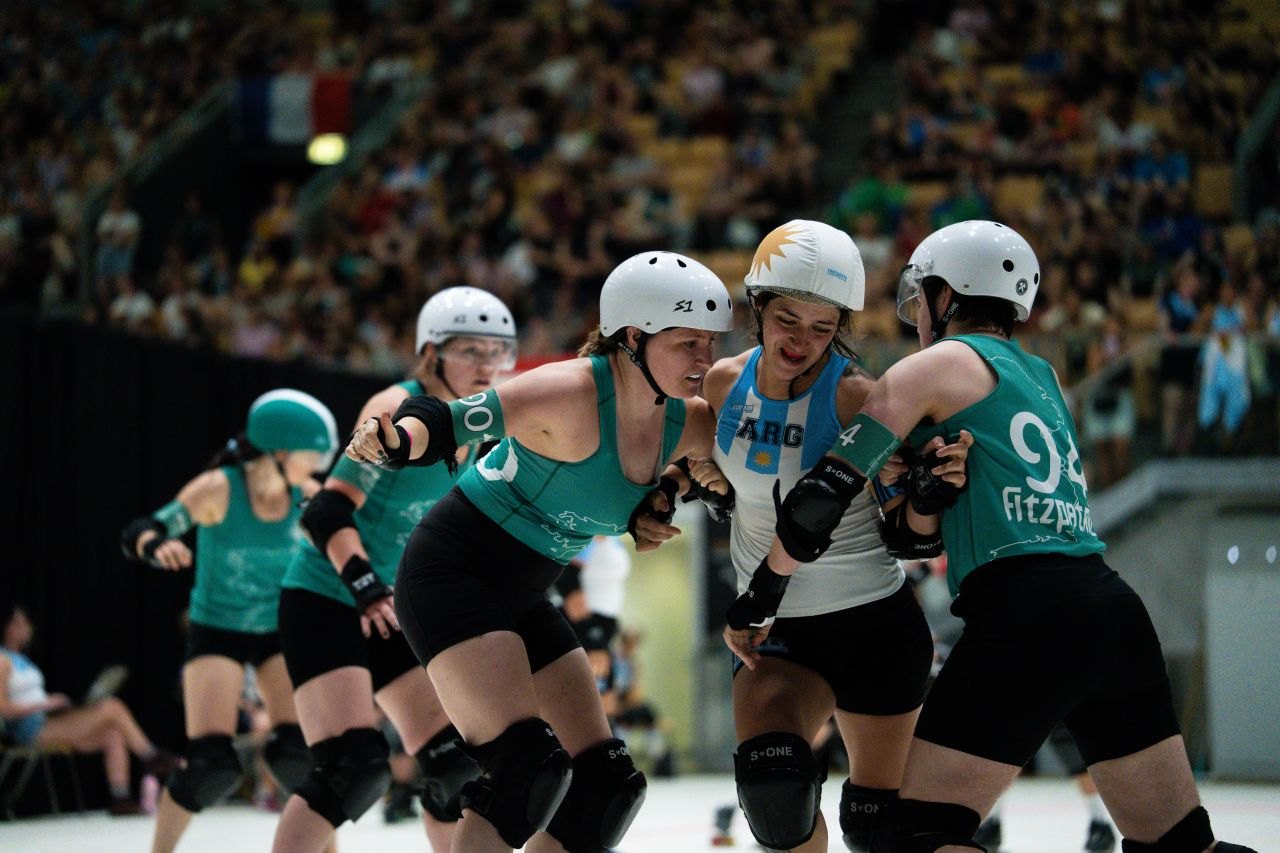
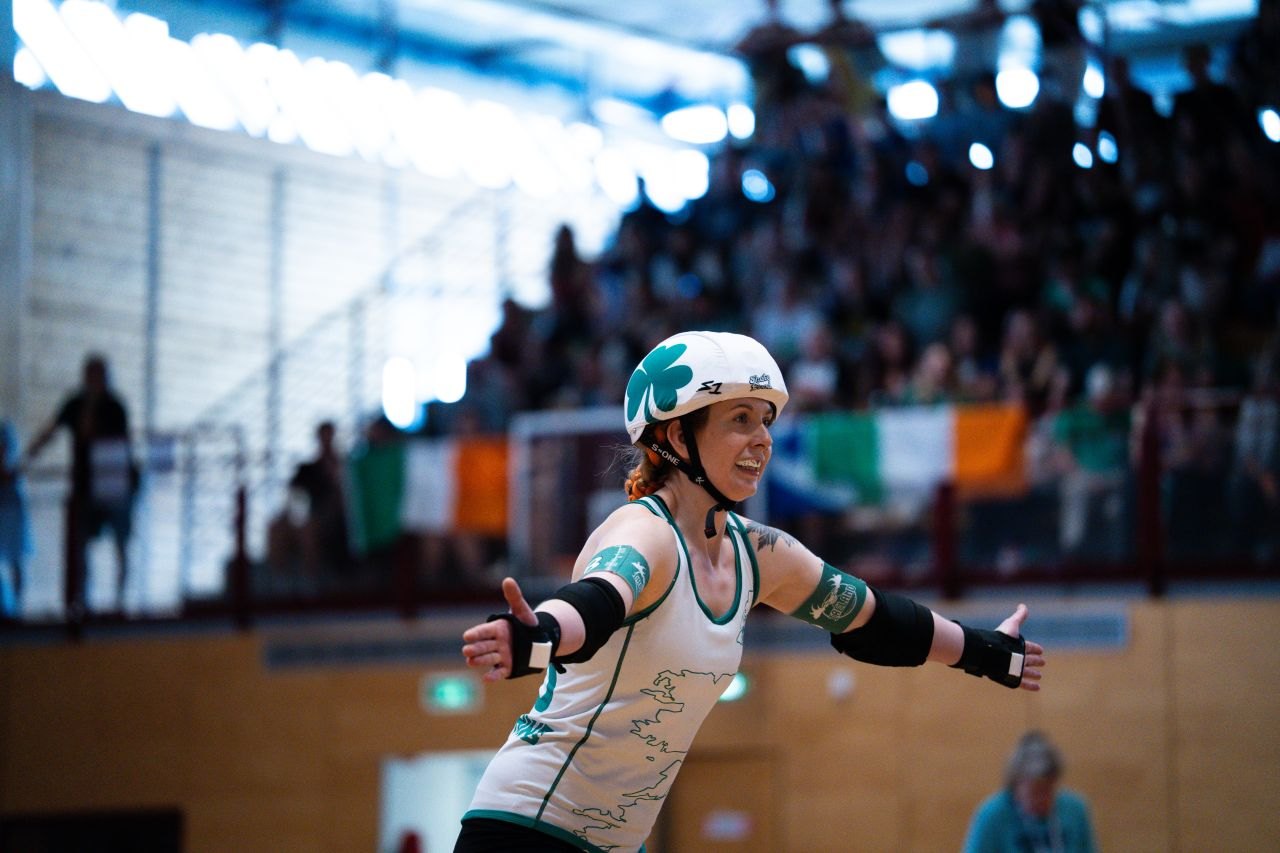
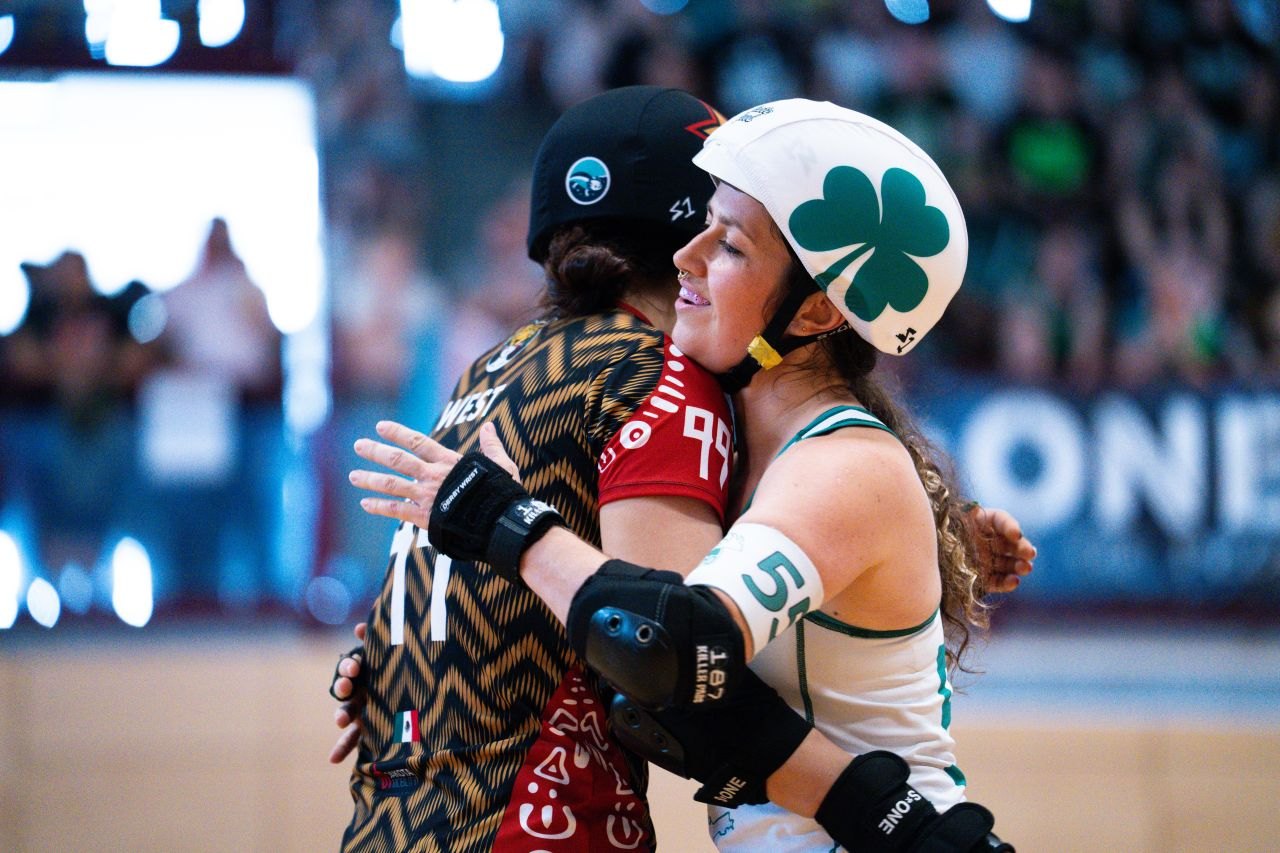
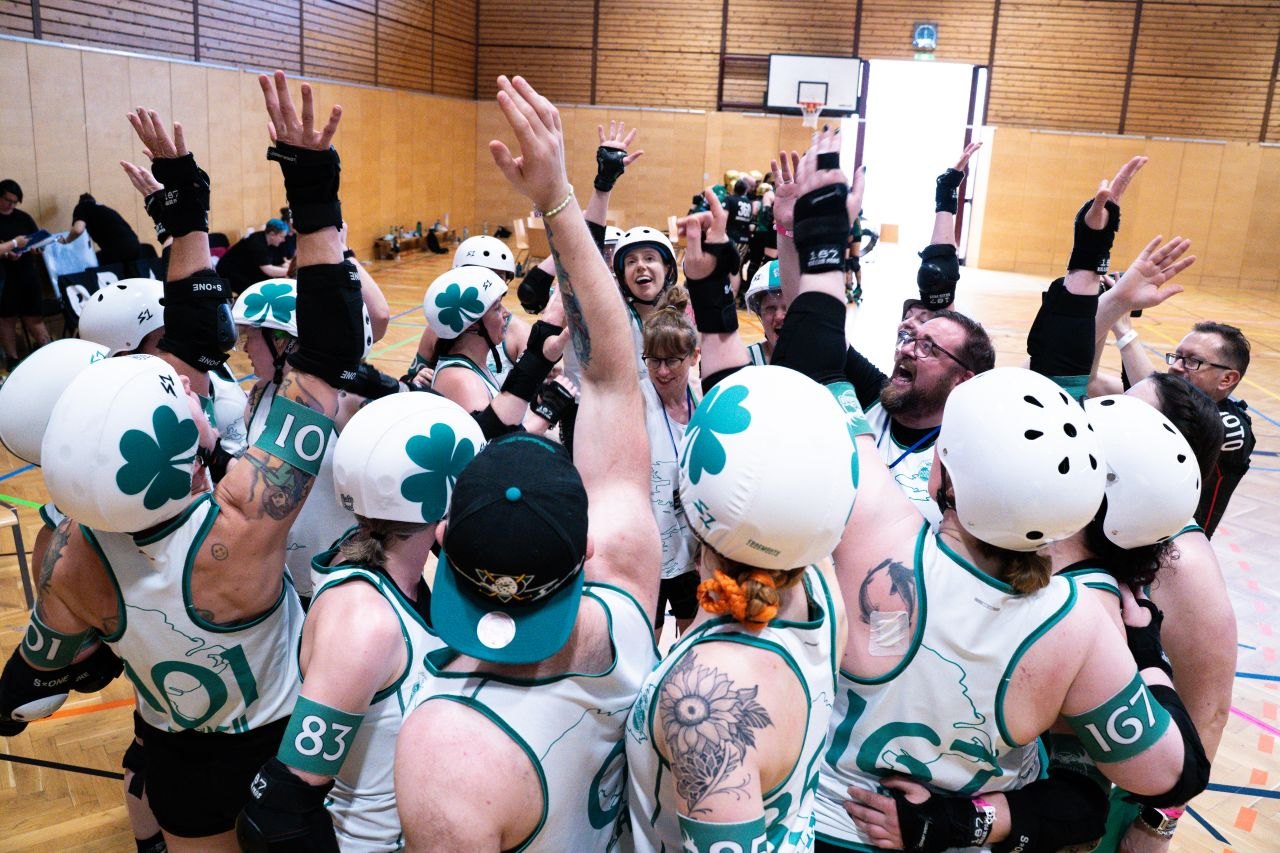
I was Team Photographer for Roller Derby Ireland's World Cup campaign: a fast, physical sport in arenas full of fans, where the shots that matter last a second. A brilliant and different experience that opened my eyes to a whole, bustling subculture.

Outside SocialTalent I also take on freelance work: documentary-style wedding videography, corporate event photography and video, and headshots for individuals and teams.